
How to Build a Sales Forecasting Model in Python (Using ARIMA and Prophet)
If you’re newer to Python and want a coding assistant alongside you while you build this, tools like Gemini Code Assist can help speed things up without replacing the learning.
Every business owner asks the same question at some point: how much will we sell next month? Guessing isn’t good enough anymore. In this guide, I’ll show you how to build a sales forecasting model in Python, using two of the most trusted time series tools in the industry — ARIMA and Prophet. You’ll see exactly what the model does, why these techniques work so well for forecasting, and how a business like yours can use one.
What Is a Sales Forecasting Machine Learning Model?
A sales forecasting machine learning model is a system that studies your past sales data and predicts what’s likely to happen next. Instead of relying on gut feeling or a simple spreadsheet trend line, the model looks at patterns — seasonality, growth trends, and recurring cycles — and turns them into a data-backed forecast.
This matters because accurate forecasts affect almost everything downstream: inventory planning, staffing, marketing budgets, and cash flow decisions. A good forecast doesn’t just tell you a number. It tells you why that number makes sense.
ARIMA vs Prophet for Sales Forecasting: Why I Chose Both
There are dozens of forecasting techniques out there, from basic linear regression to deep learning models like LSTMs. For sales data specifically, time series models tend to outperform more complex approaches, especially when the dataset is small to medium in size. Here’s why I picked these two:
ARIMA: The Statistical Workhorse
ARIMA (AutoRegressive Integrated Moving Average) is a classic statistical method designed specifically for analysing time series data. It’s excellent at capturing:
Trend — the general upward or downward direction of sales over time
Autocorrelation— how past sales values influence future ones
Stationarity patterns — Once you remove seasonal or trend effects, the underlying signal becomes predictable.
ARIMA shines when the data has a clear, consistent structure and you need an interpretable, mathematically grounded forecast.
Prophet: Built for Real-World Business Data
Prophet, developed by Meta’s data science team, was designed with business forecasting in mind. It handles the messy realities of real sales data really well, including:
Holidays and promotional spikes
Missing data points
Multiple seasonal cycles (weekly, monthly, yearly)
Sudden trend changes, like a product launch or market shift
Using ARIMA and Prophet together gave me two independent perspectives on the same data. When both models agreed on a forecast direction, I could trust it with much higher confidence.
Sales Prediction Model Using Python, Step by Step
Here’s a simplified breakdown of the pipeline I used to build the model:
1. Data collection — Historical sales data was pulled and cleaned, including dates, units sold, and revenue.
2. Exploratory analysis — I checked for seasonality, outliers, and missing values before touching any model.
3. Stationarity testing — For ARIMA, I ran an Augmented Dickey-Fuller test to confirm the data was stationary, applying differencing where needed.
4. Model training — ARIMA parameters (p, d, q) were tuned using AIC scores, while Prophet was trained with custom seasonality and holiday effects.
5. Validation — Both models were backtested against a holdout period to measure accuracy using MAE and RMSE.
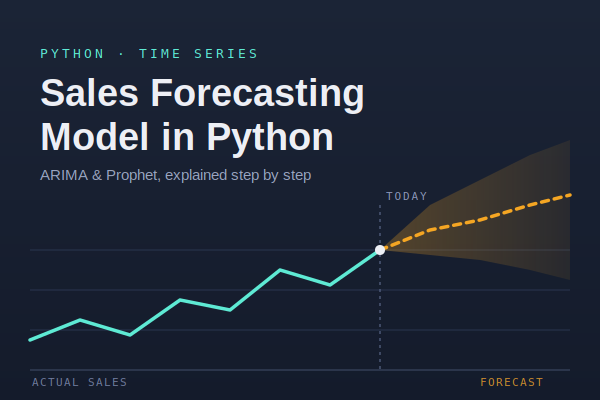
6. Forecast generation — The final model produced forward-looking predictions with confidence intervals, not just single-point guesses.
That last part is important. A forecast without a confidence interval is just a guess dressed up in decimal points. Confidence intervals tell you the realistic range of outcomes, which is far more useful for planning.
Time Series Sales Forecasting for Small Business: Real Benefits
Once the model was up and running, the practical value became obvious — especially for small business use cases where every planning decision counts:
– Smarter inventory decisions — avoid overstocking or running out during peak periods
– Better budget planning — align marketing and staffing spend with predicted demand
– Early warning signals— spot a slowdown before it shows up in the actual numbers
– Data-driven confidence — replace “I think” with “the data shows”
For a mixed audience of business owners and technical readers, the key takeaway is this: you don’t need a PhD in statistics to benefit from forecasting. You just need a properly built and validated model, along with a clear method to interpret its output. You just need a properly built and validated model, along with a clear method to interpret its output.
This isn’t just theory for big corporations, either — the same planning problem hits Etsy sellers and small e-commerce businesses every single season, and a simple forecasting model can make that guesswork a lot less stressful.
This kind of automated, data-driven decision-making is showing up everywhere in business tech right now — even in enterprise automation tools like Azure’s Agent Loop, where AI agents are starting to make adaptive decisions on their own.
Common Challenges When Building a Forecasting Model
No forecasting project is perfectly smooth. A few challenges worth knowing about:
– Short data history — Models need enough historical data to detect patterns; a few months usually isn’t enough.
– Sudden market shifts— Events like supply chain disruptions or economic changes can throw off predictions temporarily.
– Overfitting — A model that fits historical data perfectly can perform poorly on new data if it’s too complex.
Addressing these issues upfront, instead of after deployment, distinguishes a forecasting tool that people use from one that gets ignored.
Final Thoughts on Building a Sales Forecasting Model in Python
Learning how to build a sales forecasting model in Python with ARIMA and Prophet showed me just how much value lies hidden in ordinary sales data. The combination of statistical rigour and business-aware modelling created forecasts that were both accurate and genuinely usable — not just numbers on a chart, but decisions waiting to happen.
If you’re considering a similar project for your own sales data, start small: clean historical data, a simple ARIMA baseline, and Prophet for the messier seasonal effects. From there, the model only gets better.
Frequently Asked Questions
Is ARIMA or Prophet better for sales forecasting?
Neither is universally better. ARIMA works well for clean, stable time series, while Prophet handles seasonality, holidays, and irregular data more gracefully. Using both together often gives the most reliable result.
How much historical data do I need for sales forecasting?
As a general rule, at least one to two full years of data helps a model detect seasonal patterns reliably. Less data is workable but reduces accuracy.
Can a small business use a sales forecasting machine learning model?
Yes. These tools are increasingly accessible through Python libraries, and even a lightweight model built on a few years of sales data can meaningfully improve planning decisions.
Is it hard to learn how to build a sales forecasting model in Python as a beginner?
Not if you start simple. You can build a basic ARIMA model with a clean dataset using just a few lines of code, and libraries like Prophet are designed for users with minimal statistical background.
Forecast Your Business
NOW!
0092-3139806776
(Only WhatsApp)