Imran Khan’s Powerful Statement After Adiala Jail Verdict: A Call for Rule of Law and True Freedom
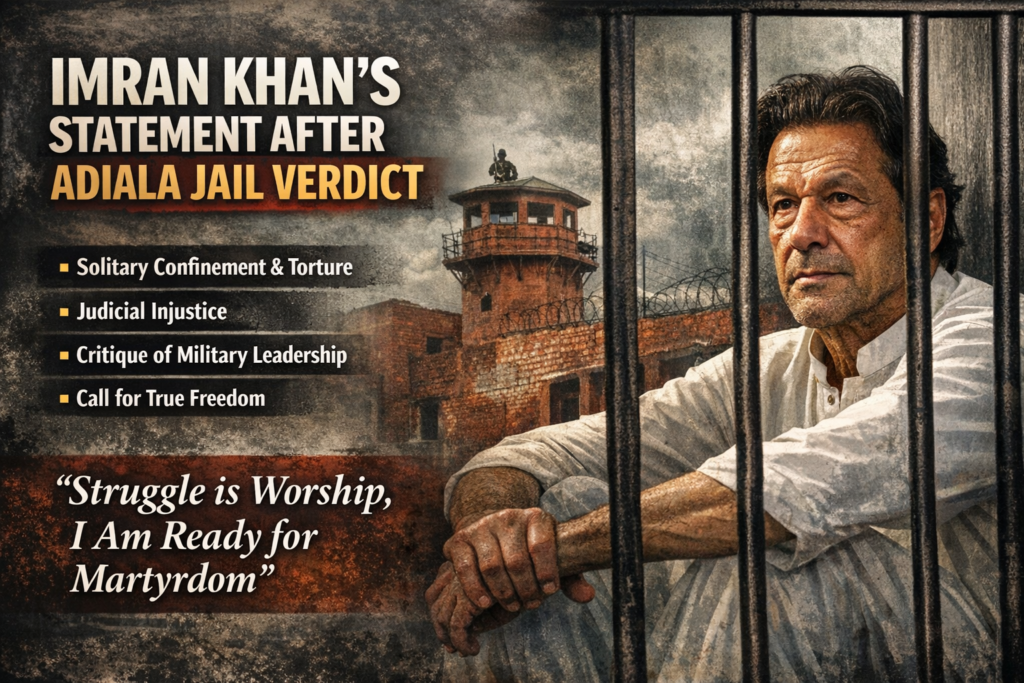
Former Prime Minister of Pakistan Imran Khan has issued a powerful and emotionally charged statement following the verdict of what he described as a “military-style trial” conducted at Adiala Jail. Speaking to his lawyers after the decision, Khan rejected the ruling outright, calling it baseless, pre-written, and delivered without due legal process.
His statement has reignited national debate over judicial independence, human rights, civil liberties, and the future of democracy in Pakistan.
“Struggle Is Worship”: Imran Khan’s Message of Resistance
At the heart of Imran Khan’s statement lies a resolute declaration:
He proclaimed, “I worship struggle, and I am ready to sacrifice my life in the fight for Pakistan’s true freedom.”
By framing political resistance as a moral and spiritual duty, Khan positioned his struggle not merely as a personal battle, but as a broader movement for constitutional supremacy and national dignity.
Rejection of the Toshakhana 2 Verdict
Imran Khan dismissed the Toshakhana 2 case verdict as another link in what he described as a chain of unjust decisions over the past three years. According to him:
- The verdict was delivered without evidence
- Legal requirements were not fulfilled
- Neither he nor his legal team were heard
- The judgment was hurried and pre-determined
These claims have intensified criticism that political forces are using Pakistan’s legal system as a tool for political engineering rather than justice.
Allegations of Solitary Confinement and Mental Torture
One of the most alarming aspects of Imran Khan’s statement concerns his detention conditions. He alleged that:
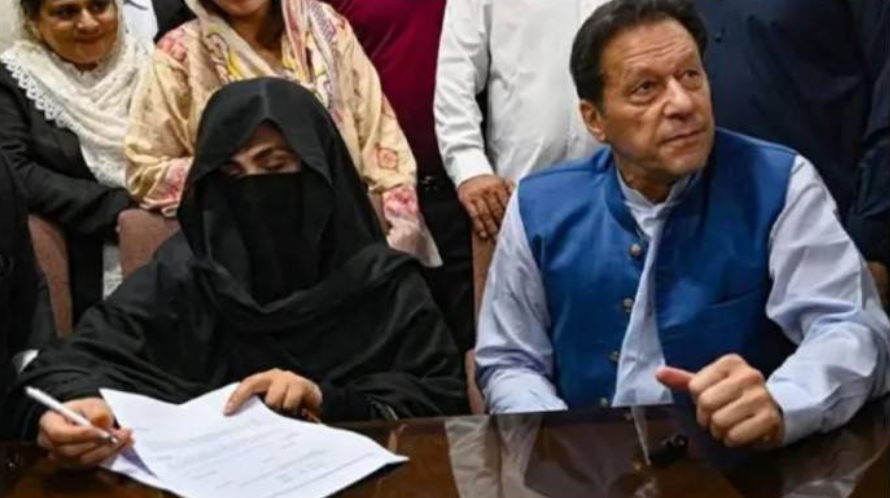
- He and his wife, Bushra Bibi, are kept in prolonged solitary confinement
- Access to television, books, and family meetings has been denied
- Jail authorities block books that family members send
- Authorities subject them to weeks-long isolation, amounting to mental torture
Khan described this treatment as inhumane, especially when compared to facilities available to ordinary prisoners.
Treatment of Bushra Bibi and Women Prisoners
Imran Khan expressed deep anguish over what he called the targeted victimisation of women, particularly his wife:
- Authorities have placed Bushra Bibi, a non-political homemaker, in solitary confinement
- He claimed that personal animosity toward him drives her detention
- He condemned the alleged mistreatment of Dr Yasmin Rashid, Mahrang Baloch, and other women
Invoking Islamic values, Khan emphasised that even during war, they protect women, making such actions morally and religiously unacceptable.
Criticism of Military Leadership and Governance
Addressing the sensitive issue of civil-military relations, Imran Khan stated clearly:
- The army belongs to the people of Pakistan, not individuals
- Criticism of General Asim Munir, he said, is criticism of a person, not the institution
- He noted that Asim Munir was not elected by public vote or referendum
Khan further alleged that officers acting under higher commands are carrying out the treatment he faces in jail based on their instructions.
Judiciary Under Fire: Comparing Today to the PCO Era
Imran Khan drew a stark parallel between the current judicial environment and the PCO judges of 2007, who validated military rule under General Musharraf.
According to him:
- Judges resisting unconstitutional pressure are national heroes
- Judges acting as “puppets” are repeating the mistakes of the past
- History, he warned, does not forgive those who compromise judicial independence
This comparison has struck a chord with legal circles and civil rights activists alike.
Call to Lawyers and the Legal Community
Emphasising the central role of justice, Khan called upon:
- Insaf Lawyers Forum
- The wider legal fraternity
to step forward in defence of the Constitution. He stressed that:
- Without the rule of law, economic development is impossible
- Moral decay follows when justice collapses
- Courts are the last shield protecting citizens’ rights
Legal Strategy: Appeal in the Islamabad High Court
Imran Khan reaffirmed his confidence in Salman Safdar and his legal team, directing them to:
- Challenge the verdict
- File appeals in the Islamabad High Court
- Expose what he termed “bogus and unlawful decisions”
This move signals that the legal battle is far from over.
Call for a Nationwide Movement
In a direct political message, Khan called on Sohail Afridi to prepare for a street movement, stating that:
- The nation must rise to reclaim its rights
- Silence in the face of injustice will only deepen the crisis
- Collective action is essential for real change
This call has raised expectations of renewed political mobilisation across the country.
Conclusion: A Defining Moment for Pakistan
Imran Khan’s statement from Adiala Jail goes beyond a legal response—it is a manifesto of resistance, blending politics, faith, law, and human rights into a single narrative.
Whether one agrees with him or not, his words highlight a critical question facing Pakistan today:
Can democracy, the rule of law, and constitutional supremacy survive without independent institutions and equal justice for all?
As the nation watches closely, this moment may well define the future political and legal trajectory of Pakistan.